Your lecturer skipped a step.
We catch it before you do.
Most confusing lectures aren't your fault, they just skip steps. LectureLift spots those gaps, teaches what's missing on the page itself, and keeps every diagram right where your lecturer put it.
It reads lectures differently.
Our AI doesn't just read, it understands what's there and more importantly, what's missing.
Your lecturer wrote this.
Lecture 07 · Dynamic Programming
Dynamic Programming solves optimization problems by breaking them into overlapping subproblems.
The optimal substructure lets us memoize recursive calls for efficiency.Greedy algorithms differ because they never reconsider earlier choices.
LectureLift notices…
Unfamiliar term
"memoize" is used but never defined
Missing background
recursion is assumed, not taught
Big leap
optimal substructure appears without setup
Unclear idea
why subproblems overlap is left implicit
Your lecturer wrote this.
Lecture 07 · Dynamic Programming
Dynamic Programming solves optimization problems by breaking them into overlapping subproblems.
The optimal substructure lets us memoize recursive calls for efficiency.Greedy algorithms differ because they never reconsider earlier choices.
LectureLift notices…
Unfamiliar term
"memoize" is used but never defined
Missing background
recursion is assumed, not taught
Big leap
optimal substructure appears without setup
Unclear idea
why subproblems overlap is left implicit
Then it teaches the missing piece.
Click any highlighted sentence to get a focused explanation, a real example, and the context you need to keep reading.
Your lecturer wrote this.
Lecture 07 · Dynamic Programming
Dynamic Programming solves optimization problems by breaking them into overlapping subproblems.
The optimal substructure lets us memoize recursive calls for efficiency.Greedy algorithms differ because they never reconsider earlier choices.
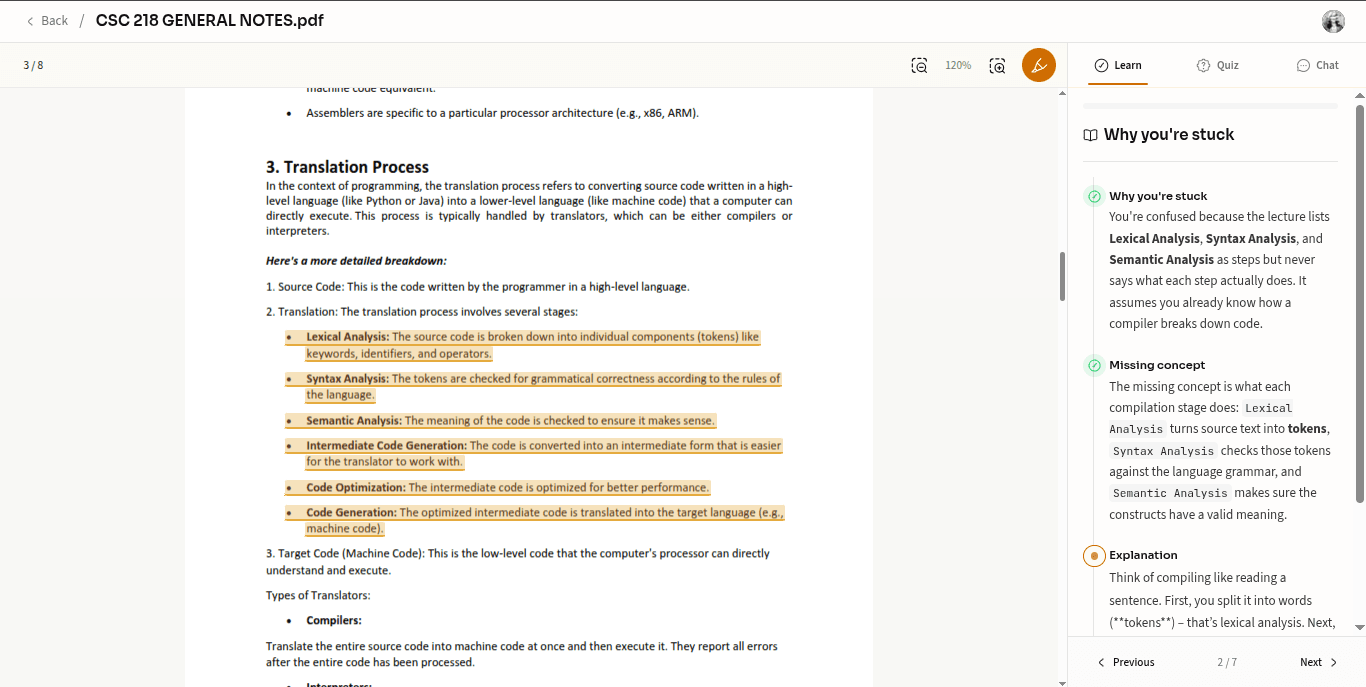
LectureLift teaches…
Why memoization works
Why you're stuck
The lecture leans on “optimal substructure” like it's obvious — but it never stops to say what that actually means.
The missing concept
Optimal substructure: a big problem whose best answer is built from the best answers of its smaller subproblems.
The explanation
Memoization means writing down the answer to a subproblem the first time you solve it — then reusing that answer instead of recomputing it. Optimal substructure guarantees those answers stay valid for every bigger problem built on top.
A real example
Like counting change: once you've counted $2, you don't recount it every time you're asked for $3, $4, or $5.
Back to your lecture
On page 3 your lecturer contrasts this with greedy algorithms — the very sentence you clicked. Now “never reconsiders” reads as the point of the whole section.
Everything you need to learn, nothing you don't.
Fewer tabs. Fewer searches. No re-asking the same question twice.
Never lose context switching between tabs.
Only the concepts you're missing are explained.
Works with the PDFs your lecturers actually give you.
Spend less time searching and more time understanding.
Finally understand
what your lecturer assumed you already knew.
Stop switching between YouTube, Google, and AI chats. Learn directly inside your lecture.